Art Deco Buildings in France Art Deco Buildings in United States Png
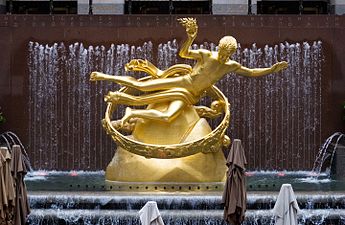
| Streamline locomotive (1939); Delano and National Hotels, Miami Embankment (1947 and 1940); Chrysler Edifice, New York City (1930); Prometheus statue at Rockefeller Center (1930) | |
| Years active | 1919-1939 |
|---|---|
| Country | U.s. |

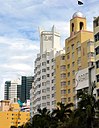
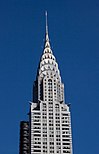


The Fine art Deco fashion, which originated in France just before World State of war I, had an important touch on on architecture and design in the United States in the 1920s and 1930s. The most famous examples are the skyscrapers of New York Metropolis including the Empire State Building, Chrysler Building, and Rockefeller Center. It combined modern aesthetics, fine craftsmanship and expensive materials, and became the symbol of luxury and modernity. While rarely used in residences, information technology was often used for function buildings, government buildings, train stations, movie theaters, diners and department stores. It also was frequently used in furniture, and in the pattern of automobiles, ocean liners, and everyday objects such as toasters and radio sets. In the late 1930s, during the Great Depression, information technology featured prominently in the architecture of the immense public works projects sponsored by the Works Progress Administration and the Public Works Administration, such as the Golden Gate Span and Hoover Dam. The style competed throughout the menstruum with the modernist architecture, and came to an abrupt end in 1939 with the commencement of World War II. The mode was rediscovered in the 1960s, and many of the original buildings accept been restored and are now historical landmarks.
Architecture [edit]
[edit]


The Fine art Deco way had been built-in in Paris, but no buildings were permitted in that city which were college than Notre Dame Cathedral (with the sole exception of the Eiffel Tower). Every bit a result, the United States soon took the pb in building alpine buildings. The get-go skyscrapers had been built in Chicago in the 1880s in the Beaux-Arts or neoclassical style. In the 1920s, New York architects used the new Art Deco style to build the Chrysler Building and the Empire State Building. The Empire Country building was the tallest building in the earth for forty years.
The ornamentation of the interior and exterior of the skyscrapers was classic Art Deco, with geometric shapes and zigzag patterns. The Chrysler Edifice, by William Van Alen (1928–30), updated the traditional gargoyles on Gothic cathedrals with sculptures on the building corners in the shape of Chrysler radiator ornaments.[1]
Another major landmark of the way was the RCA Victor Building (at present the General Electrical Building), by John Walter Cross. It was covered from elevation to bottom with zig-zags and geometric patterns, and had a highly ornamental crown with geometric spires and lightning bolts of rock. The outside featured bas-relief sculptures by Leo Friedlander and Lee Lawrie, and a mosaic by Barry Faulkner that required more than than a million pieces of enamel and glass.
While the skyscraper Art Deco style was mostly used for corporate office buildings, it also became popular for government buildings, since all city offices could be contained in ane building on a minimal amount of land. The city halls of Los Angeles, California and Buffalo, New York were congenital in the mode, likewise as the new capital building of the State of Louisiana.
Movie theaters [edit]
-
-

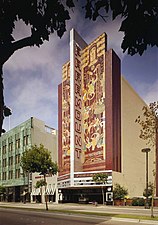
Four-story loftier grand lobby of the Paramount Theatre, Oakland (1932)
-

Paramount Theatre, Oakland; detail of the mosaic facade (1932)
Some other of import genre of Art Deco buildings is the movie theater. The Art Deco flow coincided with the nativity of the talking motion motion picture, and the age of enormous and lavishly busy motion picture theaters. Many of these moving-picture show theaters still survive, though many have been divided in the interior into smaller screening halls.
Amid the nearly famous examples are the Paramount Theatre in Oakland, California, which had a iv-story high grand lobby, entered through xx-seven doors, and could seat 3,746 people.[two]
Radio City Music Hall, located within the skyscraper complex of Rockefeller Eye in New York Metropolis, was originally a theater for stage shows when it opened in 1932, but it quickly changed to the largest movie theater in the Us. Information technology seats more than five m people, and still features a stage show of dancers before the picture showings.
In the 1930s, the streamline manner appeared in motion picture theaters in smaller cities. The movie house in Normal, Illinois (1937) is a archetype surviving example.
Department stores and office buildings [edit]

Following the pb of the skyscrapers of New York City, smaller in calibration simply no less ambitious in design, Art Deco office buildings and section stores appeared in cities across the U.s.. They were rarely built by banks, which wanted to appear conservative, but were often built past retail chains, public utilities, machine companies and technology companies, which wanted to express modernity and progress. Syracuse, New York is home to the Niagara Mohawk Building, in Syracuse, New York, completed in 1932. was originally the home of the nation's largest electricity supplier. The facade, by the firm of Bley and Lyman, was designed to express the power and modernity of electricity; it features a statue called "The Spirit of Light" 8.5 meters high, made of stainless steel, as the cardinal element of the facade. The Guardian Building, originally the Union Trust Edifice, is a rare case of a banking concern or financial establishment using Art Deco. Its interior decoration was so elaborate that it became known as the "Cathedral of Commerce". [3]
The San Francisco architect Timothy L. Pflueger best known for the Paramount Theatre in Oakland, California, was another proponent of lavish Art Deco interiors and facades on function buildings. The interior of his downtown San Francisco office edifice, 450 Sutter Street, opened in 1929, was entirely covered with hieroglyphic-like designs and ornamentation, resembling a giant tapestry. [4]
Greco Deco [edit]


Greco Deco is a term coined by Washington, DC-based art historian James M. Goode to draw a style of art and architecture popularized in the late 1920s and 1930s.[5] Arising out of the Beaux-Arts tradition, Greco Deco combined Greek and Roman traditions with those of the so fashionable Fine art Deco. The style is likewise referred to as Stripped Classical for its simpler advent compared to neoclassical compages.[6]
Greco Deco compages ofttimes expressed itself in a rather severe Greco-Roman facade busy with deco styles shallow reliefs and/or deco styled interior decoration featuring murals, tile mosaics and sculpture. A mutual motif amongst Greco Deco compages is the utilise of stylized or simplified pilasters. The style was the almost-official style of many federal and local government buildings in the Us from the mid-1920s until Earth State of war II, and frequently overlaps with the way that architectural historian David Gebhard terms "WPA Moderne."
Architects [edit]
- Albert Speer
- William J.J. Chase
- Paul Cret
- Bertram G Goodhue
- Marr & Holman
- Smith Hinchman & Grylls (at present the SmithGroupJJR)
- Wyatt C. Hedrick
- Zantzinger, Borie and Medary
- George W. Kelham
Sculptors [edit]
- Rene Paul Chambellan
- Carl Paul Jennewein
- Lee Lawrie
- Paul Manship
- Corrado Parducci
- Ulysses Ricci
The Streamline way [edit]

Streamline Moderne (or Streamline) was a variety of Art Deco which emerged during the mid-1930s. The architectural style was more sober and less decorative than earlier Art Deco buildings, more in tune with the somber mood of the Great Depression. Buildings in the style oftentimes resembled land-bound ships, with rounded corners, long horizontal lines, iron railings, and sometimes nautical features. Notable examples include the San Francisco Maritime Museum (1936), originally built every bit a public bathroom house side by side to the beach, and the Pan-Pacific Auditorium in Los Angeles, congenital in 1935 and closed in 1978. Information technology was declared a historic landmark, but it was destroyed by a fire in 1989.
The style of decoration and industrial design was influenced past modern aerodynamic principles developed for aviation and ballistics to reduce air friction at high velocities. The bullet shapes were applied past designers to cars, trains, ships, and even objects non intended to move, such as refrigerators, gas pumps, and buildings. One of the first production vehicles in this style was the Chrysler Airflow of 1933. It was unsuccessful commercially, simply the dazzler and functionality of its design set a precedent; streamline moderne meant modernity. It connected to exist used in car design well later on Earth State of war II.[7] [8] [nine] [x]
Train stations and airports [edit]
-

The Marine Air Final at LaGuardia Airport (1937) was the New York last for the flights of Pan Am Clipper flying boats.
Fine art Deco was often associated with airplanes, trains and airships and was ofttimes chosen equally the fashion for new transport terminals. The semi-dome of Cincinnati Union Terminal (1933) measures 180 feet (55 m) wide and 106 feet (32 m) high.[11] Afterward the decline of railroad travel, most of the building was converted to other uses, including the Cincinnati Museum Middle, though it is still used as an Amtrak station.
The Marine Air Terminal at LaGuardia Airport, built in 1939, was the starting time final for overseas flights from New York; it served the flying boats of Pan American World Airways which landed in the harbor. It survived devastation, and still contains a notable Art Deco landscape chosen Flight, which was destroyed and and then restored in the 1980s.
Union Station in Los Angeles was partially designed past John Parkinson and Donald B. Parkinson (the Parkinsons) who had also designed Los Angeles Urban center Hall and other landmark Los Angeles buildings. The structure combines Fine art Deco, Mission Revival, and Streamline Moderne way, with architectural details such as eight-pointed stars, and even elements of Dutch Colonial Revival architecture.[12]
Hotels, resorts, and the Miami Beach style [edit]

The Fine art Deco period saw an enormous increment in travel and tourism, by trains, automobiles, and airplanes. Several luxury hotels were built in the new manner; the Waldorf-Astoria on Park Artery in New York City, built in 1929 to supersede a beaux-arts mode building from the 1890s, was the tallest and largest hotel in the world when it was built.
The city of Miami Beach, Florida developed its own particular variant of Art Deco, and the style remained popular in that location until the tardily 1940s, well after other American cities. It became a popular tourist destination in the 1920s and 1930s, peculiarly attracting visitors from the Northeast United States during the winter. A large number of Art Deco hotels were built, which have been grouped together into an historical area, the Miami Beach Architectural District, and preserved, and many have been restored to their original appearance.[13] [fourteen] The district has an area of most one square kilometer, and contains both hotels and secondary residences, all near the aforementioned top, none higher than twelve or thirteen stories. Nigh have classic Fine art Deco characteristics; clear geometric shapes spread out horizontally; aerodynamic streamline features; and frequently a cardinal tower breaking the horizontal, topped by a spire or dome. A particular Miami Fine art Deco feature is the palette of pastel colors, alternating with white stucco. The decoration features herons, sea shells, palm trees and sunrises and sunsets. The neon lighting at night highlights the Art Deco atmosphere. [15]
Diners and roadside architecture [edit]
Because of its loftier price of construction, Art Deco was ordinarily used only in large office buildings, government buildings and theaters, but it was sometimes used in smaller structures, such as diners and gas stations, especially along highways. A notable case is the U-Drop Inn in Shamrock, Texas, located along U.S. Highway 66. Information technology was congenital in 1936, and is at present endemic by the Metropolis of Shamrock, and is an historical landmark.
In the tardily 1930s and early 1940s, a number of diners modeled after the cars of streamlined trains were produced, and appeared in different cities in the Us. In a few cases, real railroad cars were transformed into diners. A few survive, including the Modern Diner in Pawtucket, Rhode Isle which is a registered landmark.
Fine Art [edit]
Murals [edit]
-

A portion of a landscape depicting the History of Southern Illinois, commissioned by the Federal Art Project for the lLibrary of the Academy of Southern Illinois (1935)
-

Workers sorting the mail, a mural in the U.S. Community House in New York past Reginald Marsh (1936)
-

There was no specific Art Deco style of painting in the United States, though paintings were often used as decoration, especially in government buildings and office buildings. In the 1932 the Public Works of Art Project was created to give work to artists unemployed because the Great Depression. In a year, information technology commissioned more than fifteen thou works of art. Information technology was succeeded in 1935 by the Federal Arts Project of the Works Progress Administration, or WPA. prominent American artists were deputed by the Federal Art Project to paint murals in authorities buildings, hospitals, airports, schools and universities. Some the America's almost famous artists, including Grant Woods, Reginald Marsh, Georgia O'Keeffe and Maxine Albro took part in the program. The celebrated Mexican painter Diego Rivera also took part in the program, painting a mural. The paintings were in a variety of styles, including regionalism, social realism, and American scenic painting.
A few murals were besides commissioned for Art Deco skyscrapers, notably Rockefeller Center in New York. 2 murals were commissioned for the lobby, ane by John Steuart Curry and another by Diego Rivera. The owners of the edifice, the Rockefeller family, discovered that Rivera, a Communist, had slipped an prototype of Lenin into a oversupply in the painting, and had it destroyed.[xvi] The mural was replaced with another by the Spanish artist José Maria Sert.[17]
Sculpture [edit]
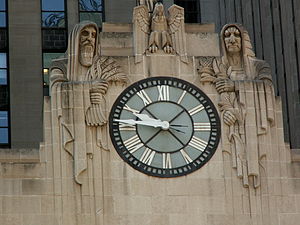

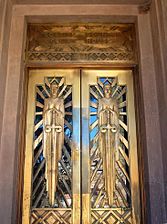
One of the largest Art Deco sculptures is the statue of Ceres, the goddess of grain and fertility, at the top of the Chicago Board of Trade. Made of aluminum, information technology stands 31 feet (ix.4 meters) tall, and weighs six,500 pounds. Ceres was chosen because the Chicago Board of Merchandise was 1 of the largest grain and bolt markets in the globe.
Graphic Arts [edit]
-

Affiche for Chicago World's Fair (1933)
-

WPA Poster warning against crossing the street confronting the light (1937)
-
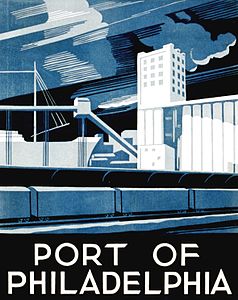
WPA poster advertising Port of Philadelphia (1937)
-

WPA "Swim for Health" poster (1938)
-

WPA Tourism promotion affiche for state of Pennsylvania (1938)
The Art Deco style appeared early in the graphic arts, in the years just before Globe War I. It appeared in Paris in the posters and the costume designs of Léon Bakst for the Ballets Russes, and in the catalogs of the fashion designers Paul Poiret. The illustrations of Georges Barbier, and Georges Lepape and the images in the fashion mag La Gazette du bon ton perfectly captured the elegance and sensuality of the way. In the 1920s, the look changed; the fashions stressed were more than casual, sportive and daring, with the woman models usually smoking cigarettes. American fashion magazines such as Vogue, Vanity Fair and Harper's Bazaar quickly picked up the new way and popularized it in the United States. It also influenced the work of American book illustrators such as Rockwell Kent.[18]
In the 1930s a new genre of posters appeared in the United States during the Great Depression. The Federal Art Projection hired American artists to create posters to promote tourism and cultural events.
PWA Moderne [edit]


PWA Moderne (or "P.Westward.A. Moderne", PWA/WPA Moderne,[19] Federal Moderne,[20] Depression Moderne,[19] Classical Moderne,[19] Stripped Classicism) is an architectural mode of many buildings in the United States completed between 1933 and 1944,[20] during and shortly afterwards the Groovy Depression as part of relief projects sponsored by the Public Works Assistants (PWA) and the Works Progress Administration (WPA).
The style draws from traditional motifs such as Beaux-Arts classicism and Fine art Deco and is similar to Streamline Moderne,[xx] [21] often with zigzag ornamentation added. The structures reflect a greater use of conservative and classical elements and have a monumental feel. They include post offices, train stations, public schools, libraries, borough centers, courthouses,[20] museums, bridges, and dams across the state. Banks were also congenital in the fashion because such buildings radiated authority.[xix]
Elements of the mode [edit]
Typical elements of PWA Moderne buildings include:[nineteen]
- Classical counterbalanced and symmetrical form
- Windows arranged as vertical recessed panels
- Surfaces sheathed in smooth, flat rock or stucco
Examples [edit]
Examples of PWA buildings and structures include:
Arizona/Nevada [edit]
- Hoover Dam (Boulder Dam) – on the Colorado River in Arizona and Nevada.[22] [23]
- Arizona State Fairgrounds Grandstand (1936–1937) – Phoenix, Arizona. The exterior of the grandstand has 23 bas-relief panels past David Carrick Swing and Florence Blakeslee, that were funded by the Federal Art Project.[24] [25]
- WPA Administration Building (1938) – at 19th Avenue and McDowell Road on the Arizona State Fairgrounds, Phoenix, Arizona. It was headquarters for Works Progress Administration−WPA projects in Arizona.[26] [27] [28]
Florida [edit]

Ed Austin Building (Old Federal Courthouse, current Florida Land Attorney's Office), Jacksonville, Florida
- Jacksonville
- Ed Austin Building (erstwhile Federal Courthouse, electric current Country Chaser's Office), 1933, Marsh & Saxelbye
California [edit]
Greater Los Angeles [edit]

Venice Police Station, Los Angeles


- Burbank: Burbank Urban center Hall, Allen Lutzi[29]
- Culver City:
- Helms Bakery, 1930, Eastward. L. Bruner
- MGM Studios, 1938–39, Claude Beelman, Beaux-Arts in the guise of PWA Moderne
- El Segundo: El Segundo Unproblematic School, 1936
- Hermosa Beach: North Schoolhouse, 1934 Samuel Lunden (Per File #19-45 of DSA Records); Pier Avenue School, 1939, March, Smith, and Powell
- Inglewood: Inglewood Memorial Park, buildings 1933 and 1940, Walter E. Erkes
- Lancaster: Mail service Office (1940, Louis A. Simon and old School Building (c. 1937)
- Lawndale: Leuzinger High School, T.C. Kistner & Cómo.; Kistner & Curtis; Eugene D. Birnbaum and Associates[29]
- Long Beach
- Jefferson Junior High School Edifice, 1936
- Long Beach Main Post Role, 1934, Louis A. Simon and James A. Wetmore
- Municipal Utilities Building, 1932, Dedrick and Bobbe
- Robert Louis Stevenson schoolhouse, c. 1936
- Veteran'due south Memorial Edifice 1936–37, George Kahrs
- Los Angeles:
- Abraham Lincoln Loftier School (Lincoln Heights), 1937–38, Albert C. Martin
- Carpenter Community Charter Schoolhouse
- Distribution Station #28, Department of Water and Power (West Fifty.A.), 1945–46, G. Eastward. Benker, engineer
- Federal Building and Mail service Office (now U.S. Federal Courthouse), 1938–1940, Louis A. Simon
- Hall of Assistants, 1956–1961: A continuation of the PWA Moderne manner in the 1950s
- Hollywood Branch Post Function, 1937, Claude Beellman, Allison and Allison
- Pacific Stock Substitution, 1929–xxx, Samuel E. Lunden
- Police force and Fire Station of Venice, c. 1930
- San Pedro High School, 1935–1937, Gordon B. Kaufmann
- Sepulveda Dam, 1941, inundation control dam on the Los Angeles River in the San Fernando Valley, 1939–1941, War Section
- U.S. Customs House and Post Function (San Pedro), 1935
- U.S. Naval and Marine Corps Armory, 1939–40, Stiles Clements
- University of Southern California campus: Alan Hancock Foundation and Memorial Museum, 1940, Cram and Ferguson
- Pasadena:
- Armory Gallery (former California State Armory), 1932, Bennett and Haskell
- Grover Cleveland Simple School, 1934
- San Gabriel: San Gabriel Union Church and School, 1936
- Santa Monica:
- Santa Monica Metropolis Hall, 1938–39, Donald B. Parkinson and J. M. Estep
- Post Office, Robert Dennis Murray, Louis A. Simon[29]
- Torrance:
- Auditorium (Torrance Loftier School)
- Torrance Public Library, 1936, Walker & Eisen
- Whittier:[30]
- National Trust and Savings, c. 1935, William H. Harrison
- Whittier Post Office, 1935, Louis A. Simon
- Whittier-Marriage Loftier School, 1939–40, William H. Harrison
Elsewhere in California [edit]

- Bakersfield: Kern County Hall of Records, 1939 remodel, Chris Brewer
- Fresno: Canton Hall of Records, 1937, Centrolineal Architects of Fresno[31]
- Jackson: Amador County Courthouse, 1940 remodel, George Sellon[32]
- Oakland: Alameda County Courthouse, 1939[33]
- Salinas: Monterey County Courthouse, 1937, Robert Stanton & Charles Butner[34]
- San Diego: San Diego County Administration Center, 1938, Samuel Woods Hamill, William Templeton Johnson, Richard Requa, Louis John Gill[35]
- San Francisco: San Francisco Mint, 1937
- San Luis Obispo: San Luis Obispo County Courthouse, 1940, Walker & Eisen[36]
- Santa Cruz: Santa Cruz Borough Auditorium, 1939[37]
- Visalia: Tulare County Courthouse (at present Department of Public Social Services), 1935, Ernest Kump[38] [39]
Commune of Columbia (Washington, D.C.) [edit]


- Folger Shakespeare Library, 1932, Paul Philippe Cret[20]
- Library of Congress Annex (John Adams Building), 1939, Pierson & Wilson[20]
- Harry Southward Truman Building (particularly the War Department building) of the United States Department of Land, 1939, Underwood & Foster[40]
Iowa [edit]

Sioux City Municipal Auditorium. The smooth brick walls, rounded corners, and deeply incised openings typify the Moderne style.
- Animosa: Jones Canton Courthouse, 1937, Dougher, Rich and Woodburn
- Audubon: Audubon County Court House, 1940, Keffer and Jones
- Atlantic: Cass County Courthouse, 1934, Dougher, Rich and Woodburn
- Burlington: Des Moines Canton Courtroom House, 1940, Keffer and Jones
- Charles Metropolis: Floyd County Courtroom House, 1940, Hansen & Waggoner
- Dakota City: Humboldt County Courthouse, 1939
- Independence: Buchanan Canton Court House, 1940, Dougher, Rich and Woodburn
- Indianola: Warren County Court Firm, 1939, Keffer and Jones
- St. Olaf: St. Olaf Auditorium, 1939
- Sioux City: Sioux City Municipal Auditorium, 1938–50, Knute E. Westerlind
- Waukon: Allamakee County Court House, 1940, Charles Altfillisch
- Waverly: Bremer Canton Court House, 1937, Mortimer Cleveland
Minnesota [edit]
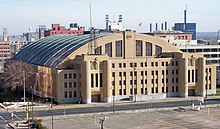

William K. Nakamura Federal Courthouse, Seattle, WA
- Minneapolis: Minneapolis Armory, 1935–36, P.C. Bettenburg; Walter H. Wheeler
Mississippi [edit]
- Mississippi: Amory National Baby-sit Armory, 1937–38, Overstreet & Boondocks
Nevada [edit]
- Pioche: Lincoln County Courthouse, 1938, A. Lacy Worswick; L.F. Dow
Oregon [edit]
- Salem: Oregon Land Capitol, 1938, Trowbridge & Livingston
Tennessee [edit]
- Nashville: Martin Luther Male monarch Magnet at Pearl High School
Texas [edit]
- Austin: Heman Marion Sweatt Travis County Courthouse 1930,1931, Folio Brothers
- Longview: Gregg County Courthouse 1932, Voelcker and Dixon[41]
Utah [edit]
- Orderville: Valley School
- Provo: Superintendent'due south Residence at the Utah State Hospital, 1934 (Colonial Revival/PWA Moderne)
- Santaquin: Santaquin Inferior High School
Washington [edit]
- Seattle: William K. Nakamura Federal Courthouse, 1940, Gilbert Stanley Underwood[42]
See too [edit]
- List of Art Deco architecture
- Listing of Art Deco architecture in the Us
- Fine art Deco architecture of New York City
- Moderne compages
- Streamline Moderne architecture
- WPA Rustic compages
References [edit]
Notes and citations [edit]
- ^ Morel2012, p. 151.
- ^ Stone, Susannah Harris. The Oakland Paramount, Lancaster-Miller Publishers (1982) - ISBN 0-89581-607-v
- ^ Duncan 1988, p. 193.
- ^ Duncan 1988, p. 198.
- ^ James G. Goode (one December 1981). Capital Losses: A Cultural History of Washington's Destroyed Buildings. Smithsonian Institution Press. pp. 178, 188. ISBN978-0-87474-479-viii . Retrieved five April 2013.
- ^ "Detect a Building: Search".
- ^ Gartman, David (1994). Machine Opium. Routledge. pp. 122–124. ISBN978-0-415-10572-9.
- ^ "Curves of Steel: Streamlined Motorcar Blueprint". Phoenix Art Museum. 2007. Retrieved 1 September 2010.
- ^ Armi, C. Edson (1989). The Art of American Car Pattern. Pennsylvania Land Academy Press. p. 66. ISBN978-0-271-00479-2.
- ^ Hinckley, James (2005). The Big Book of Car Civilization: The Armchair Guide to Automotive Americana. MotorBooks/MBI Publishing. p. 239. ISBN978-0-7603-1965-9.
- ^ Cincinnati Union Last Architectural Data Sheet Archived 2010-06-20 at the Wayback Machine. Cincinnati Museum Centre. Retrieved on February 8, 2010
- ^ Waldie, D.J. (May one, 2014) "Marriage Station: L.A.'s nearly perfect time machine" Op-Ed, Los Angeles Times.
- ^ "Our Mission Statement". Miami Pattern Preservation League. Retrieved 7 December 2012.
- ^ Brown, Joseph (2009). "Miami Beach Art Deco". Miami Beach MagazineFebruary 2010. Archived from the original on 31 January 2010.
- ^ Duncan 1988, pp. 203–205.
- ^ "Archibald MacLeish Criticism". Enotes.com. Retrieved 2011-12-08 .
- ^ Morel 2012, p. 155.
- ^ Duncan 1988, pp. 148–150.
- ^ a b c d due east Fullerton Heritage site
- ^ a b c d due east f The Grove Encyclopedia of American Art, Book 1, Joan M. Marter, ed., p. 147
- ^ McGraw-Hill Dictionary of Compages and Construction
- ^ Arizona.edu: "The New Deal in Arizona: Connections to Our Celebrated Landscape", University of Arizona, The New Deal in Arizona Chapter of the National New Deal Preservation Association.
- ^ Arizona.edu: Photos of New Bargain projects in Arizona
- ^ KJZZ.org: "Did Yous Know: Arizona State Fairgrounds 110 Years Old", by Nadine Arroyo Rodriguez, 21 August 2015; with images of the WPA Grandstand and Administration Building.
- ^ Living New Bargain Blog: Arizona State Fairgrounds Stadium and Art
- ^ Phoenix New Times: "Demolition of WPA Borough Building at Arizona State Fairgrounds on Temporary Hold", eighteen July 2014.
- ^ Youtube.com: "1938 WPA Administration Building in 1949 & 1969"
- ^ "Azfamily.com: "$200,000 to go toward preserving State Fairgrounds WPA Assistants Edifice"". Retrieved 10 April 2016.
- ^ a b c "PWA Moderne", Los Angeles Conservancy website
- ^ An Curvation Guidebook to Los Angeles, Robert Winter, p. 322
- ^ "Fresno Canton, US Courthouses". Retrieved 11 Aug 2016.
- ^ "Amador County, Us Courthouses". Retrieved 11 Aug 2016.
- ^ "Alameda County, United states of america Courthouses". Retrieved 11 Aug 2016.
- ^ "Monterey County, United states Courthouses". Retrieved 11 Aug 2016.
- ^ "San Diego County, US Courthouses". Retrieved eleven Aug 2016.
- ^ "San Luis Obispo County, United states Courthouses". Retrieved 11 Aug 2016.
- ^ "Santa Cruz Civic Auditorium - Santa Cruz CA - Living New Deal". Retrieved 11 Aug 2016.
- ^ "Tulare County, US Courthouses". Retrieved 11 Aug 2016.
- ^ "Tulare County Department of Public Social Services - Visalia CA - Living New Deal". Retrieved eleven Aug 2016.
- ^ "Harry Due south. Truman Federal Building, Washington, DC".
- ^ "Gregg County Courthouse, Longview, Texas". www.texasescapes.com . Retrieved 16 March 2018.
- ^ "William Yard. Nakamura Federal Courthouse - Seattle WA - Living New Deal". Retrieved 11 Aug 2016.
Bibliography [edit]
- Bayer, Patricia (1999). Fine art Deco Architecture: Design, Decoration and Detail from the Twenties and Thirties. Thames & Hudson. ISBN978-0-500-28149-9.
- Benton, Charlotte; Benton, Tim; Wood, Ghislaine; Baddeley, Oriana (2003). Art Deco: 1910–1939 . Bulfinch. ISBN978-0-8212-2834-0.
- Cakewalk, Carla (2003). American Art Deco: Modernistic Architecture and Regionalism. Westward. W. Norton. ISBN978-0-393-01970-4.
- Duncan, Alastair (1988). Art déco . Thames & Hudson. ISBNtwo-87811-003-10.
- Duncan, Alaistair (2009). Fine art Deco Consummate: The Definitive Guide to the Decorative Arts of the 1920s and 1930s. Abrams. ISBN978-0-8109-8046-4.
- Gallagher, Fiona (2002). Christie's Art Deco. Pavilion Books. ISBN978-1-86205-509-4.
- Hillier, Bevis (1968). Art Deco of the 20s and 30s. Studio Vista. ISBN978-0-289-27788-1.
- Long, Christopher (2007). Paul T. Frankl and Modernistic American Design . Yale University Press. ISBN978-0-300-12102-5.
- Lucie-Smith, Edward (1996). Fine art Deco Painting. Phaidon Press. ISBN978-0-7148-3576-1.
- Morel, Guillaume (2012). Art Déco (in French). Éditions Identify des Victoires. ISBN978-two-8099-0701-8.
- Savage, Rebecca Binno; Kowalski, Greg (2004). Art Deco in Detroit (Images of America). Arcadia. ISBN978-0-7385-3228-8.
- Vincent, Chiliad.K. (2008). A History of Du Pikestaff Court: Land, Architecture, People and Politics. Woodbine Printing. ISBN978-0-9541675-1-half-dozen.
- Ward, Mary; Ward, Neville (1978). Habitation in the Twenties and Thirties. Ian Allan. ISBN0-7110-0785-3.
External links [edit]
-
 Media related to Fine art Deco in the U.s. at Wikimedia Commons
Source: https://en.wikipedia.org/wiki/Art_Deco_in_the_United_States
0 Response to "Art Deco Buildings in France Art Deco Buildings in United States Png"
Post a Comment